Sunday, January 31, 2016

Battle of Amiens-Aussie Awesomeness!

It's a new year for awesome wargaming in the Tactical Gaming Society and we got off to a great start with Richard's presentation of the Battle of Amiens.  Using modified Bolt Action rules, Richard gave us some Great War action that involved an unusual amount of maneuver, much like the actual battle in 1918.

I'll leave the full BatRep to Richard.  Here I will focus on my portion of the battle-an Australian assault platoon on the right flank.  Comprised of four infantry sections and two tanks, we replicated the tough-as-nails quality of the Aussies by giving them the "Tough Fighters" special rule, which made them especially dangerous in close combat.

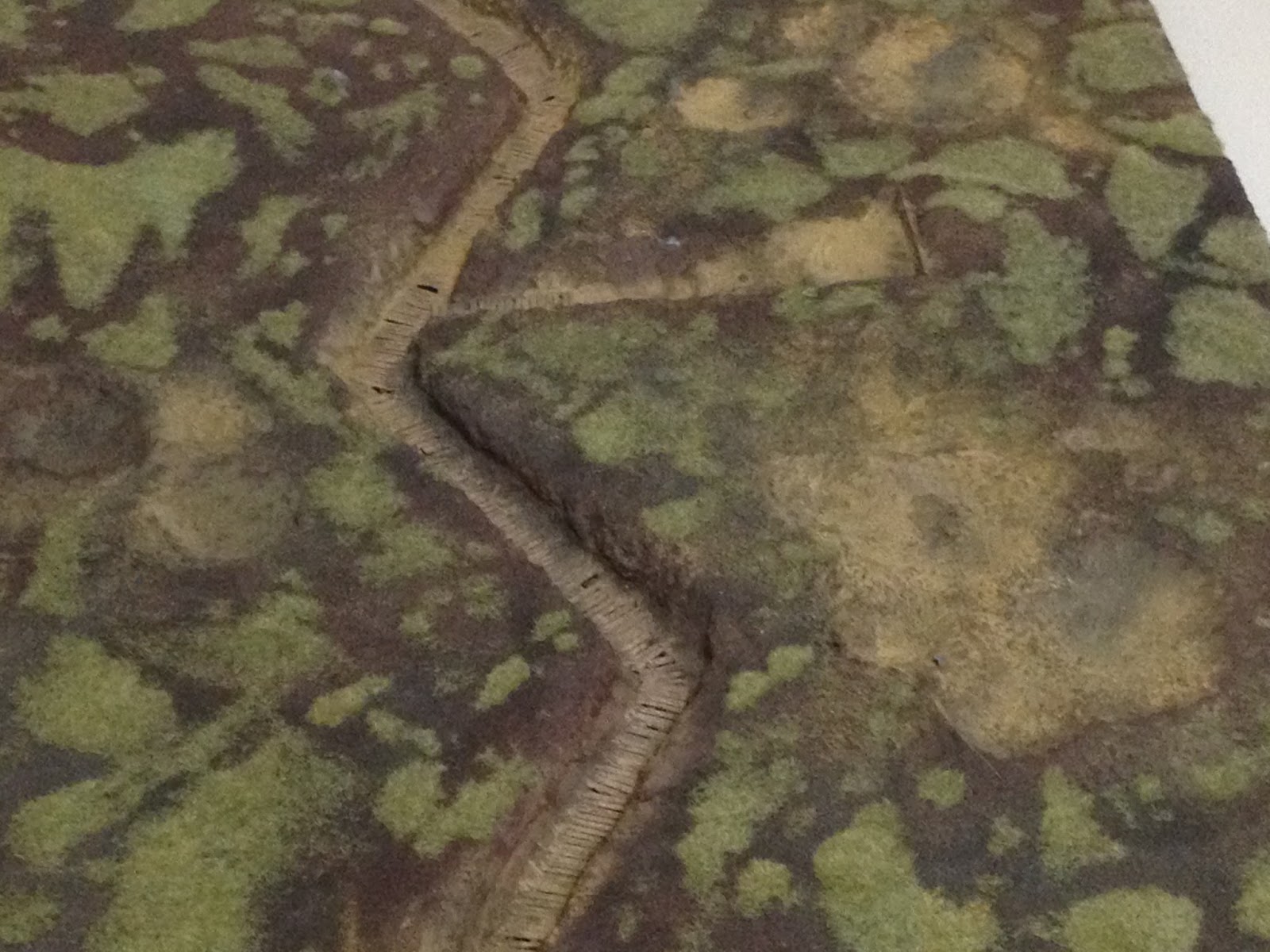
First things first.  Check out the awesome table that Richard made for the game.  His goal was to replicate the pastoral landscape of the Amiens battlefield, which was fairly unspoiled when compared with other more contended regions of the Western Front.  I'd call this success.  Check out the duckboarding.  Mindblowingly detailed.


A few fresh craters give a preview of things to come.


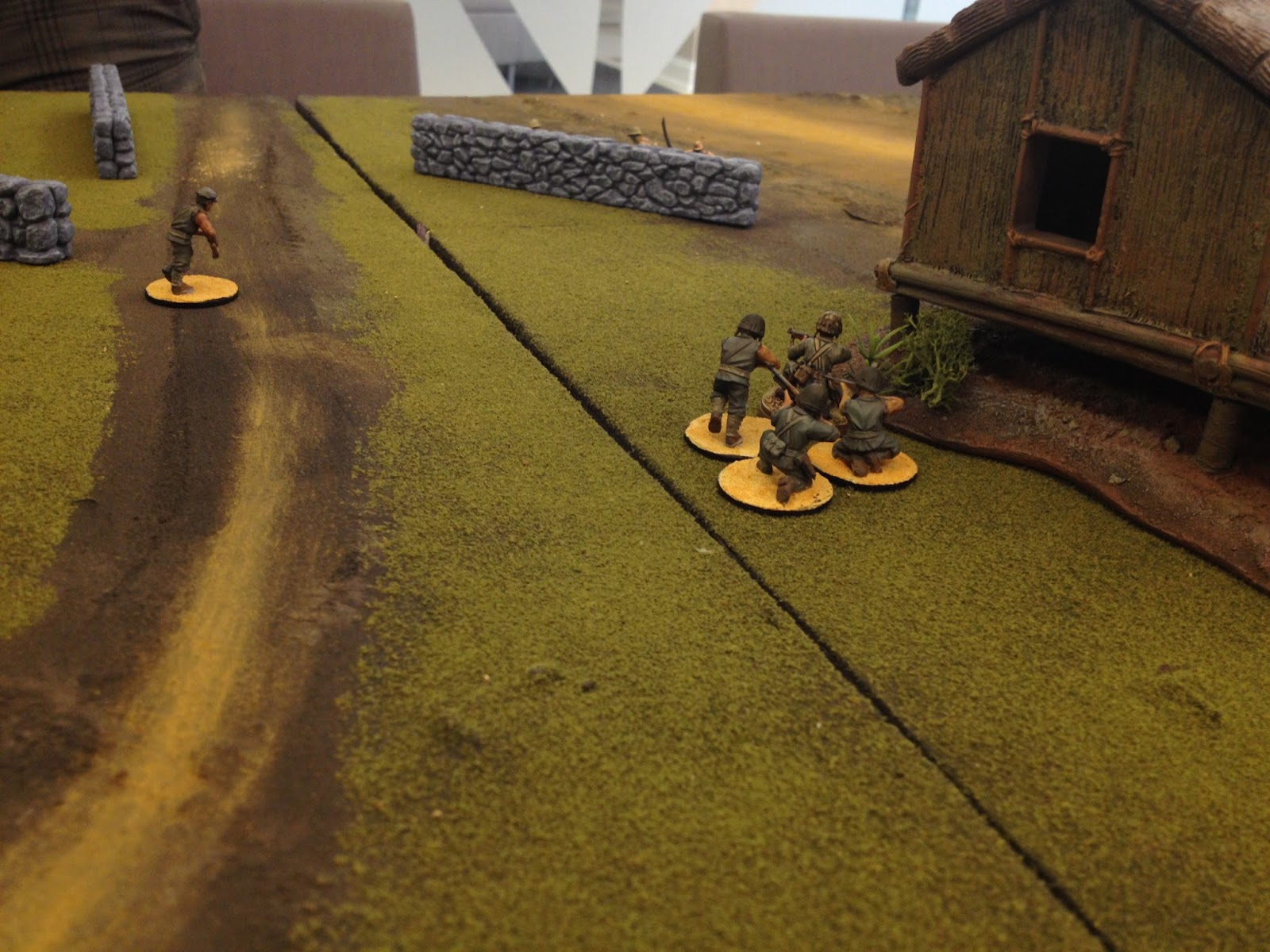
Here's my platoon.  Richard went with 18mm, which allowed us to play a company sized-game in a scale that made the battlefield look right.

Following a massive rolling artillery barrage.  I started by advancing my tanks on the right.

As the tanks prepared to knock holes in the barbed wire, I moved my infantry squads up and prepared to assault the first line of trenches.

Which they did with frightening efficiency.


Having brushed the German defenders aside in the first trench, the Aussies prepare to assault the second trench line.


Using a downed Sopwith Camel as a guide, the Aussies continue their advance across the alarmingly open ground.


The German artillery, having recovered from the Commonwealth bombardment, starts to gain hits against the Aussie tanks, disrupting the advance somewhat.


But no worries.  On the far right flank one squad uses a tank for cover to get within assault range of the second line of German trenches.


A German flamethrower team managed to set my lead tank alight, causing the crew to bail out, but the Infantry squad bypassed the burning wreck and gained the second trench line with another devastating assault.


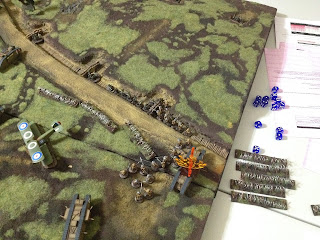

The Germans tried to eject the hard-bitten Aussies from their new claim with machine gun fire, mortar fire, and counter assaults from two units.  Nothing would dislodge the Diggers now that their blood was up and they ended the game with the furthest advance of all commonwealth forces.  Kind of like it really went down in 1918.


A very very good game.  My teammates Gavin and Keith had a tougher go of things in the center and on the left, where a German MG and an improbably resilient flamethrower team had some good effects against tanks and infantry squads.  Speaking of a tough go, our valiant opponents, Casey, Rhett, and John had difficulties from the get go due to some hot artillery rolls on our part (which they were unable to match with their artillery rolls over the course of the game).  Had the German players the hotter dice, our advance would have been slowed significantly.

Great game.  It looked right, it played right, and it was a ton of fun with six very good players and a top-notch GM.  I really like playing with the smaller scale.  It looks much better than 28mm for this size battle.

Game well.

Tuesday, January 5, 2016

Water Effect Follow-Up

Back in August I took you through the struggles of my first attempt at blue water water effects.  If you remember, I was using acrylic gel medium for the first time.  I wanted some real depth to the water, so I got a tub of super heavy acrylic gloss medium and slathered it onto my test panel.  After a week, it looked like this:


I promised I would get back to you with the results once the gel clarified.  It is now nearly five months since I schmeared the test panel, and this is what it looks like:


As you can see, the super heavy gel medium holds whatever shape and surface marks you make (intentionally or not), so you can sculpt turbulence and waves into the medium, but you have to be very careful and deliberate with the technique you use to manipulate the gel.  Another problem is that the gel is too clear.  The transparency and clarity creates the illusion of a cup of sloshing water magically contained on the surface of a styrofoam panel colored with blue and ochre pigment.  Does not really evoke ocean.  I'm sure a skilled sculptor could make this work, especially for a large-scale display model.  For 28mm and smaller wargaming, though, this isn't going to cut it.


Finally, there are the bubbles deep inside the cured gel.  Again, a really talented sculptor could make these work.  I cannot.


So, in the end, I fall in line and recommend what so many other, more experienced water effect modelers have been saying all along: Create the illusion of depth with paint or pigments applied to the board surface and then use a thin coat(s) of acrylic gloss medium to model the water surface and waves.  Like this:


Game well!

Wednesday, October 28, 2015

Halloween Game--Zombies in Normandy

Check out this excellent write-up from our Halloween game over at The Rogue General Hunter!

Thanks to Bob for the excellent report and to John for the excellent game.

Saturday, September 19, 2015

John's Normandy Game

Go check out John and Rhett's Normandy game here.  Sorry I missed this one.

Game well.

Sunday, August 30, 2015

Guadalcanal Table and Battle Report

Today we played the long-awaited Guadalcanal game.  Expectations were high for this one, and Rhett did not disappoint.  He definitely delivered a very tight scenario with solid mechanics that conveyed the situations in which the USMC and Imperial Army historically found themselves in this fight.

The scenario was intended to represent the final Japanese offensive against the Henderson Field perimeter.  While the wargame was definitely representational rather than literal, it certainly captured the feeling of the USMC gaining dominance on the island while the Japanese hurl the last of their dwindling, but very hard-hitting force against a tough defensive position.  It was a very fun game.

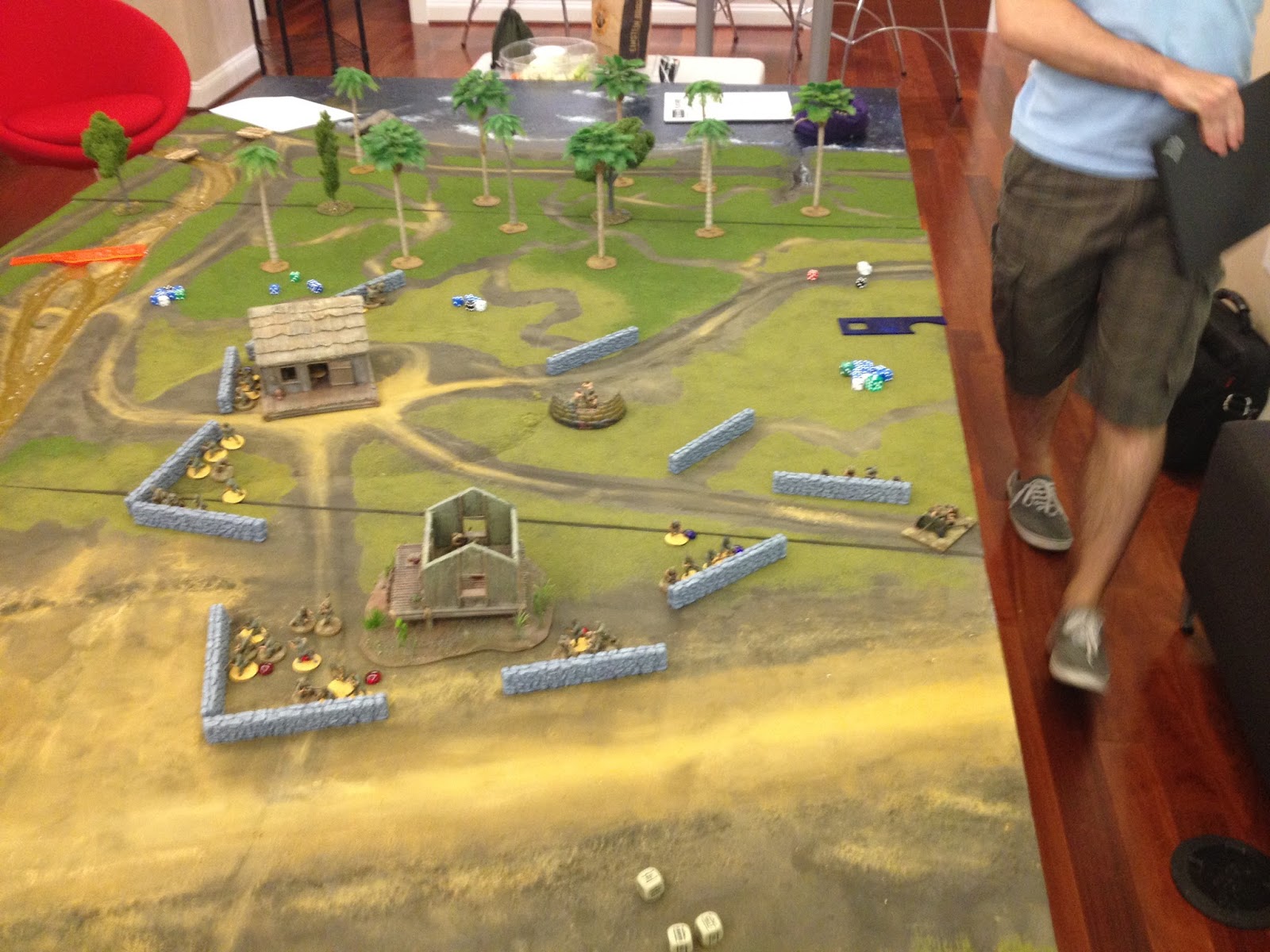
First things first, though, here's how the table turned out.  It was OK.  If the Lungga river looked more like muddy water and less like butterscotch pudding left too long in the sun, it would have been a really great table.

The waves worked pretty well.  I used snow flock to produce bubbly wakes trailing out behind each wave.  Definitely lends motion to the ocean panel.  I ended up applying three coats of acrylic gloss medium over the initial water effect laydown.


The volcanic soil turned out to be just the right color, and I like the way the the light sienna pigment produced some dusty contrast in high-traffic areas.


The go-to move of dry pigments fixed using denatured alcohol again produced amazingly realistic runoff effects.

And then there was the river.  The sad, cracked, lumpy, bubbly Lungga River.  Well, when you are starting out not every water effect gets to be the best water effect.  This was a definite miss.  I will fix it with acrylic gloss and pigment if we end up taking this table to a competition, but for now I'm just chalking this up to a learning experience.  I think I need to use less acrylic gel medium in water effects that are meant to be smooth.


On to the game.  Gavin, Drew and I played the Japanese attackers.  Rich and Owen played the USMC defenders.  The scenario called for two attacks on successive nights.  We treated the first attack as a reconnaissance in force to see how the Marines would react to a penetration of their perimeter.  We advanced with my platoon on the right, Gavin's platoon on the left, and Drew's platoon in reserve.

Because it was a night attack scenario, no units could be targeted at a range of over 18" unless there was an illumination flare in play.  Both sides used flares to varying degrees of success.

Rich and Owen use a flare to illuminate the lead squads of the Japanese attack.

The Marine firepower took a pretty good toll on the Japanese as they advanced, but not enough to knock out any squads.

I have to say that Owen was rolling hits and wounds like a Boss today.  Definitely had the hot hand.

The first wave of Japanese assaults hits the USMC line.  Once in close combat, the Japanese were devastating and Marines started to fall like wheat before the scythe.

But the Corps had an answer for that shit: flamethrowers.  They would take a decisive toll on the attackers over the course of both attacks.

Our support position on the ridge south of the airfield did not play a decisive role in either of the attacks.  Very hard to get after the Marines in buildings and hard cover.  A few pin markers, but only one or two casualties.


The Japanese sweep the Marines from the perimeter.  In the center you can see a single Japanese soldier attacking the building with explosives, which causes sufficient damage to cause secondary explosions inside the structure, killing the Marines inside.  Boom.


This is how the first engagement ended.  The Marine perimeter is compromised, but forces are repositioning to meet the threat.  Here, the lone remaining Japanese troop, armed with explosives, is hauling ass toward the remaining structure to blow it up.  But the Marines deployed another flamethrower team and, well, that was that.


During the following day, the Marines got busy restructuring their defensive perimeter.

The Japanese launched their second attack form the same place, but narrowed our front to limit our exposure to the USMC direct fire.  Which worked very well...

...but did not work very well with regard to indirect fire.  The Marines surprised us with artillery support in the second attack, which played holy hell with our densely-packed attack column.

Even with the addition of infiltration teams (our game 2 surprise) flanking along the river to the West to take advantage of the Marines repositioning to meet our main attack, the second game was never really in question.  The initial Japanese assault hit very hard and again cleared-away the first line of USMC defenders, but the Marines had more than enough capability left to recover and deal with the attackers.  Flamethrowers.  Daaaaaamn.


The victors and the GM.  Well-played, fellas.


All in all this was a very fun game with finely-crafted special rules.  Big props to Rhett for a high-quality event.  During the post game discussion we talked about the challenges GMs face in developing scenarios that remain true to history while at the same time keep players emotionally invested in the outcome.  As Gavin rightly pointed out, no battle is ever balanced and fair.  Any general that seeks a fight with even odds is doing war wrong.  Turing that imbalance into a fun wargame is our art form.


Friday, August 28, 2015

Things that Matter in Wargaming

I was looking for a pirated copy of WSS #78 so I could share the full text of Phil Dutré's excellent article, 'The irregular - It's the figures, stupid!'.  While searching (and failing), I came across this gem posted on Big Andy's.

Always fun to encounter those with a healthy perspective on the range of possibilities our shared hobby offers beyond the tournament.


Back to  Dutré's article, reading it reminds me of one of the most distrurbing trends I encountered while slogging around in the 40k scene: people building an army tooled-up for the current edition and then discarding it on eBay once it was no longer the 'it' army build.  I understand the constraints of budget, especially with regard to obscenely overpriced GW product, but this practice occupies the same piteous place in my heart where I contemplate destitute unfortunates selling their blood to buy food.

I do believe that people for whom the miniatures are simply a means to an end are missing out on one of the greatest elements of our hobby.

And Andy, I'm with you, Sir.  Wargaming without umpires is like drinking beer without beer.

Friday, August 21, 2015

Guadalcanal Table Part 2

So, things are not going real well.

I tested super heavy acrylic gloss gel medium, and I thought it would work great, which it would, if I had three months to let the gel dry and clarify.  Not going to work this time around (although I am excited about the prospect of working in heavy gel medium in the future.)

Here is what the test panel looks like with a thick schmear of super heavy gloss gel.  I'll show you another picture in late Autumn, it may have dried by then.


But now I am out of time.  I could go small and lame and douse the water with varnish and call it good.  But that's not my style.

I really want to make the spot where the muddy water of the river mixes with the clear ocean water work, and the only way to do that is with a medium that gives some depth to the water effect.  I went back to the art store and bought some Liquitex medium acrylic gloss gel and a tub of acrylic gloss medium/varnish.  I mixed about one part gel to two parts varnish, and rolled the dice.

I kind of sucked.  Applying the gel totally disrupted the modulation pattern I had carefully laid down with the blue pigments and turned the whole ocean part into hodge-podge impressionist seascape.

Nothing to do but move forward.

I next mixed about 1 part gel with 4 parts varnish and about a half-tablespoon of light sienna pigment, and carefully poured the river.  This went OK, but I am very nervous that it will dry with a concave surface (if it dries with any body depth at all).  I have also accepted the reality of bubbles in the river due to mixing the medium, but I'll worry about those later (I went through and popped the big ones).

Thoroughly dissatisfied with the way the ocean looked, I scooped some medium gel medium directly onto it, sprinkled the lumps liberally with snow flock (foam and bubbles), and stirred them into waves using a toothpick and a "sideways tornado" stirring motion to replicate water turning in waves.  Finally, I filled the lagoon with acrylic gloss medium.  I have absolutely no idea what I am doing at this point.  Here's how it looks right now:


If I am very lucky, the waves will dry and clarify by game time next Sunday.  The river and lagoon should dry in a couple of days, so I can go back and fix them if they are too assed-up to live with.

Alia iacta est.  Tune in in early September to see how it turned out.