Today we played the long-awaited Guadalcanal game. Expectations were high for this one, and Rhett did not disappoint. He definitely delivered a very tight scenario with solid mechanics that conveyed the situations in which the USMC and Imperial Army historically found themselves in this fight.
The scenario was intended to represent the final Japanese offensive against the Henderson Field perimeter. While the wargame was definitely representational rather than literal, it certainly captured the feeling of the USMC gaining dominance on the island while the Japanese hurl the last of their dwindling, but very hard-hitting force against a tough defensive position. It was a very fun game.
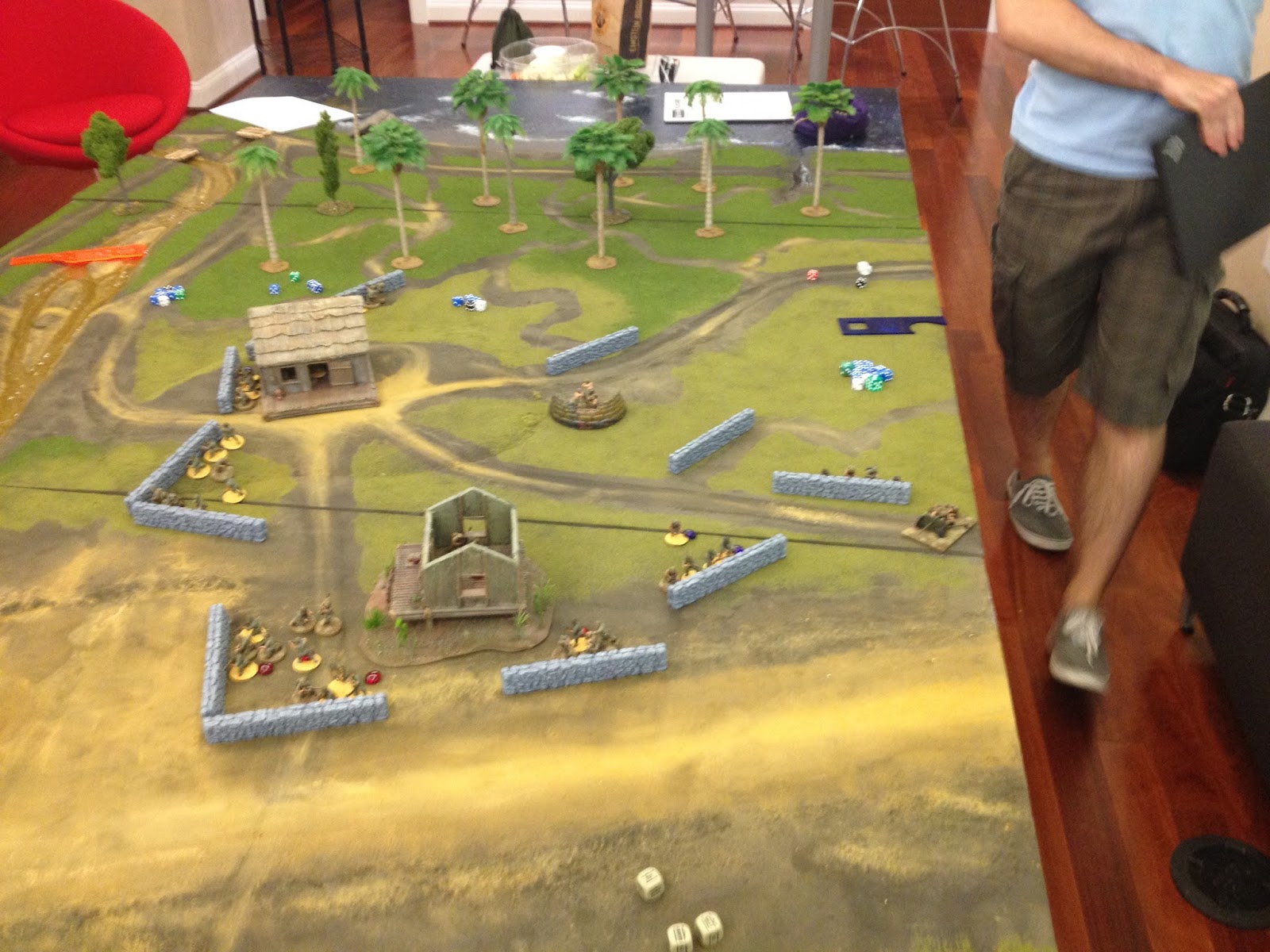
First things first, though, here's how the table turned out. It was OK. If the Lungga river looked more like muddy water and less like butterscotch pudding left too long in the sun, it would have been a really great table.
The waves worked pretty well. I used snow flock to produce bubbly wakes trailing out behind each wave. Definitely lends motion to the ocean panel. I ended up applying three coats of acrylic gloss medium over the initial water effect laydown.
The volcanic soil turned out to be just the right color, and I like the way the the light sienna pigment produced some dusty contrast in high-traffic areas.
The go-to move of dry pigments fixed using denatured alcohol again produced amazingly realistic runoff effects.
And then there was the river. The sad, cracked, lumpy, bubbly Lungga River. Well, when you are starting out not every water effect gets to be the best water effect. This was a definite miss. I will fix it with acrylic gloss and pigment if we end up taking this table to a competition, but for now I'm just chalking this up to a learning experience. I think I need to use less acrylic gel medium in water effects that are meant to be smooth.
On to the game. Gavin, Drew and I played the Japanese attackers. Rich and Owen played the USMC defenders. The scenario called for two attacks on successive nights. We treated the first attack as a reconnaissance in force to see how the Marines would react to a penetration of their perimeter. We advanced with my platoon on the right, Gavin's platoon on the left, and Drew's platoon in reserve.
Because it was a night attack scenario, no units could be targeted at a range of over 18" unless there was an illumination flare in play. Both sides used flares to varying degrees of success.
Rich and Owen use a flare to illuminate the lead squads of the Japanese attack.
The Marine firepower took a pretty good toll on the Japanese as they advanced, but not enough to knock out any squads.
I have to say that Owen was rolling hits and wounds like a Boss today. Definitely had the hot hand.
The first wave of Japanese assaults hits the USMC line. Once in close combat, the Japanese were devastating and Marines started to fall like wheat before the scythe.
But the Corps had an answer for that shit: flamethrowers. They would take a decisive toll on the attackers over the course of both attacks.
Our support position on the ridge south of the airfield did not play a decisive role in either of the attacks. Very hard to get after the Marines in buildings and hard cover. A few pin markers, but only one or two casualties.
The Japanese sweep the Marines from the perimeter. In the center you can see a single Japanese soldier attacking the building with explosives, which causes sufficient damage to cause secondary explosions inside the structure, killing the Marines inside. Boom.
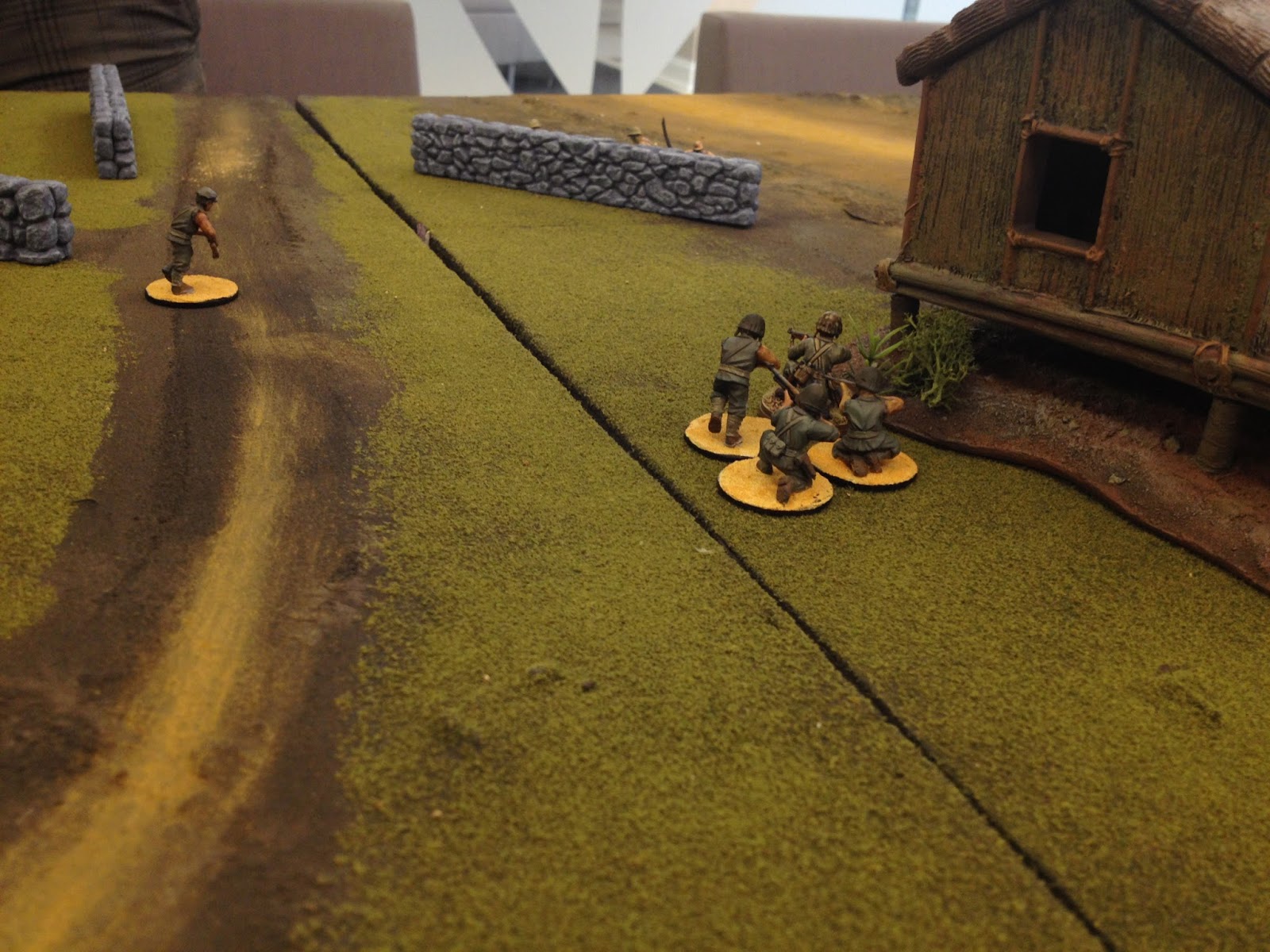
This is how the first engagement ended. The Marine perimeter is compromised, but forces are repositioning to meet the threat. Here, the lone remaining Japanese troop, armed with explosives, is hauling ass toward the remaining structure to blow it up. But the Marines deployed another flamethrower team and, well, that was that.
During the following day, the Marines got busy restructuring their defensive perimeter.
The Japanese launched their second attack form the same place, but narrowed our front to limit our exposure to the USMC direct fire. Which worked very well...
...but did not work very well with regard to indirect fire. The Marines surprised us with artillery support in the second attack, which played holy hell with our densely-packed attack column.
Even with the addition of infiltration teams (our game 2 surprise) flanking along the river to the West to take advantage of the Marines repositioning to meet our main attack, the second game was never really in question. The initial Japanese assault hit very hard and again cleared-away the first line of USMC defenders, but the Marines had more than enough capability left to recover and deal with the attackers. Flamethrowers. Daaaaaamn.
The victors and the GM. Well-played, fellas.
All in all this was a very fun game with finely-crafted special rules. Big props to Rhett for a high-quality event. During the post game discussion we talked about the challenges GMs face in developing scenarios that remain true to history while at the same time keep players emotionally invested in the outcome. As Gavin rightly pointed out, no battle is ever balanced and fair. Any general that seeks a fight with even odds is doing war wrong. Turing that imbalance into a fun wargame is our art form.